


Which Insurance Company Is the Strongest in Singapore? Updated 2026
- Derrick Lee
- Jul 12
- 5 min read

When purchasing insurance, most people compare premiums, coverage, policy benefits, and perhaps even the reputation of the insurer. However, one important factor is often overlooked—the financial strength of the insurance company itself.
While Singapore is home to one of the world's most robust and well-regulated insurance industries, insurers differ in terms of financial strength, capital reserves, global operations, and independent credit ratings.
A life insurance policy is a long-term commitment. Whether it's a term plan, whole life policy, critical illness coverage, or an investment-linked policy (ILP), you are placing your trust in an insurer to honour its promises many years—even decades—into the future.
What do insurer financial strength ratings mean, who assigns them, how Singapore's major insurers compare, and how these ratings should be used when making insurance decisions.
Why Financial Strength Matters
Insurance is built on a promise.
When you pay your premiums, you're relying on the insurer to be financially capable of paying future claims whenever they arise. Unlike many financial products, insurance contracts often last 20, 30, or even 50 years.
Independent financial strength ratings help assess an insurer's ability to meet these long-term obligations.
Why should policyholders care?
A financially strong insurer generally demonstrates:
Strong Financial Stability
The ability to withstand economic downturns and market volatility.
Healthy Capital Reserves
Sufficient capital to support future claims.
Greater Claims Confidence
An independent indication of long-term claims-paying ability.
Long-Term Sustainability
Especially important for policies designed to last decades.
Peace of Mind
Knowing that your insurer has been independently assessed by recognised rating agencies.
While financial strength does not guarantee future performance, it provides valuable insight into an insurer's overall financial resilience.

Who Determines These Ratings?
Several internationally recognised rating agencies evaluate insurance companies around the world.
S&P Global Ratings
One of the most respected rating agencies globally, S&P assesses an insurer's financial strength, risk management, profitability, capital adequacy, and long-term ability to meet financial obligations.
Fitch Ratings
Fitch evaluates insurers based on:
- Capital adequacy
- Business profile
- Enterprise risk management
- Profitability
- Investment strategy
AM Best
Unlike general credit rating agencies, AM Best specialises exclusively in the insurance industry and has more than a century of experience analysing insurers.
Moody's
Moody's also evaluates insurers' financial strength, although not every insurer operating in Singapore maintains a Moody's rating.
Understanding Financial Strength Ratings
The following table provides a simplified interpretation of common financial strength ratings.
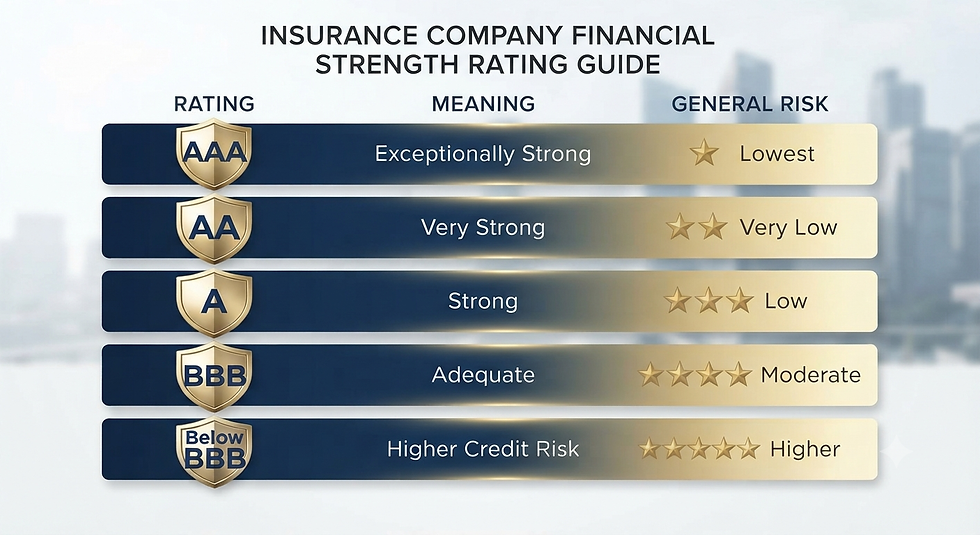
Important: These ratings measure an insurer's financial strength—not the quality of its insurance products or customer service.
An AA-rated insurer isn't automatically "better" than an A-rated insurer if another insurer offers a policy that is more suitable for your needs.
Singapore Insurance Company Financial Strength Ratings (2026)
Below is a summary of publicly available financial strength ratings for selected insurers operating in Singapore.

Note: Financial strength ratings are assigned by different agencies using different methodologies and should not always be compared directly. Ratings and outlooks may change over time as agencies conduct periodic reviews.
Does a Higher Rating Mean Better Insurance?
Not necessarily.
One of the biggest misconceptions is that the insurer with the highest financial strength rating automatically offers the best insurance policy.
In reality, choosing insurance involves much more than comparing ratings.
For example:
- One insurer may offer more comprehensive critical illness definitions.
- Another may provide lower premiums for young families.
- Some insurers may be more accommodating during underwriting for specific medical conditions.
- Others may offer a wider range of investment options for ILPs.
Financial strength should therefore be viewed as one important consideration—not the only one.
Singapore Has One of the World's Strongest Insurance Regulatory Frameworks
Singapore's insurance industry is regulated by the Monetary Authority of Singapore (MAS).
MAS requires insurers to maintain robust capital adequacy, solvency margins, governance standards, and enterprise risk management practices. These stringent requirements help safeguard policyholders and contribute to the stability of Singapore's insurance sector.
While no insurer is entirely risk-free, Singapore's regulatory environment provides a high level of confidence in the overall resilience of the industry.
What I Consider Before Recommending an Insurer
After advising clients for more than a decade, I've learned that the question shouldn't be:
"Which insurer has the highest rating?"
Instead, the better question is:
"Which insurer and policy are most suitable for my financial goals?"
When helping clients evaluate insurance options, I consider several key factors:
✅ Financial strength of the insurer
✅ Suitability of the policy
✅ Coverage and policy definitions
✅ Underwriting philosophy
✅ Claims-paying track record
✅ Premium affordability
✅ Long-term servicing and support
Financial strength is important—but it forms only one part of a comprehensive financial planning process.
Frequently Asked Questions
Is an AA-rated insurer always better than an A-rated insurer?
No. An AA rating reflects stronger financial capacity, but an A-rated insurer may still be financially strong and offer products that are more suitable for your needs and budget.
Should financial strength be my only consideration?
No.
You should also evaluate:
- Policy features
- Coverage
- Exclusions
- Premium affordability
- Claims philosophy
- Underwriting approach
- Long-term financial objectives
Are insurer ratings permanent?
No.
Independent rating agencies regularly review insurers based on financial performance, profitability, capital adequacy, market conditions, and business outlook. Ratings may be upgraded, downgraded, or affirmed over time.
Are Singapore insurers safe?
Singapore has one of the strongest insurance regulatory frameworks globally. MAS imposes strict solvency and capital requirements, helping to ensure insurers remain financially sound and capable of meeting their obligations to policyholders.
Key Takeaways
Before purchasing any insurance policy, consider these five questions:
✔ Is the insurer financially strong?
✔ Does the policy meet my protection needs?
✔ Can I comfortably afford the premiums over the long term?
✔ Do the policy definitions and benefits suit my situation?
✔ Does the plan align with my overall financial goals?
Remember, insurance is not simply about buying the "highest-rated" company. It's about selecting the right combination of financial strength, suitable coverage, affordability, and long-term value.
Insurance is ultimately built on trust.
When you purchase a policy, you are placing your confidence in an insurer to support you and your loved ones during life's most challenging moments. Independent financial strength ratings provide valuable insight into an insurer's financial resilience and its ability to honour long-term commitments.
However, ratings should never be viewed in isolation. The best insurance solution is one that combines a financially sound insurer with a policy that fits your personal circumstances, protection needs, and long-term financial objectives.
As an experienced financial advisor, my role is not simply to recommend the highest-rated insurer, but to help clients make informed decisions based on a balanced assessment of financial strength, policy suitability, affordability, and overall value.
By understanding how insurer ratings work, you'll be better equipped to make confident and informed decisions for yourself and your family.
Need Professional Advice?
Choosing the right insurance policy can be overwhelming, especially with so many insurers and products available in Singapore.
If you'd like an objective comparison across multiple insurers or a review of your existing coverage, I'd be happy to help you understand your options and build a protection strategy that aligns with your financial goals.
Disclaimer
This article is intended for general educational purposes only and should not be construed as financial advice or a recommendation to purchase any insurance product. Financial strength ratings are published by independent rating agencies and may change over time. Readers should consider their own financial circumstances and consult a qualified financial advisor before making insurance decisions.


Comments